
Issue 5 — From Reactive to Condition-Based Maintenance

After data begins to work for operations, maintenance teams often reach an uncomfortable realisation:
They are still working hard —but reacting too often.
When Maintenance Is Always Urgent
In many water utilities, maintenance activity is driven by:
- Fixed schedules
- Alarms that demand immediate attention
- Failures that cannot be ignored
This approach keeps assets running, but at a cost.
Teams are busy.
Resources are stretched.
Failures feel familiar — and frustratingly repetitive.
The problem is not effort.
It is timing.
Why Reactive Maintenance Persists
Reactive maintenance persists because it feels safe.
A pump fails → it is repaired.
An alarm triggers → it is addressed.
A schedule arrives → work is done.
These actions are visible, measurable, and defensible. But they are also blind to gradual change.
Slow degradation, abnormal stress, and early warning signs often go unnoticed — not because data is missing, but because it is not being used in context.
The Shift Toward Condition-Based Thinking
When utilities begin using operational history meaningfully, maintenance conversations start to change.
Instead of asking:When is the next scheduled service?
Teams begin asking:
- Is this asset behaving differently from before?
- Is its condition changing faster than expected?
- Should maintenance happen now — or can it wait?
This marks the move from time-based maintenance to condition-based maintenance.
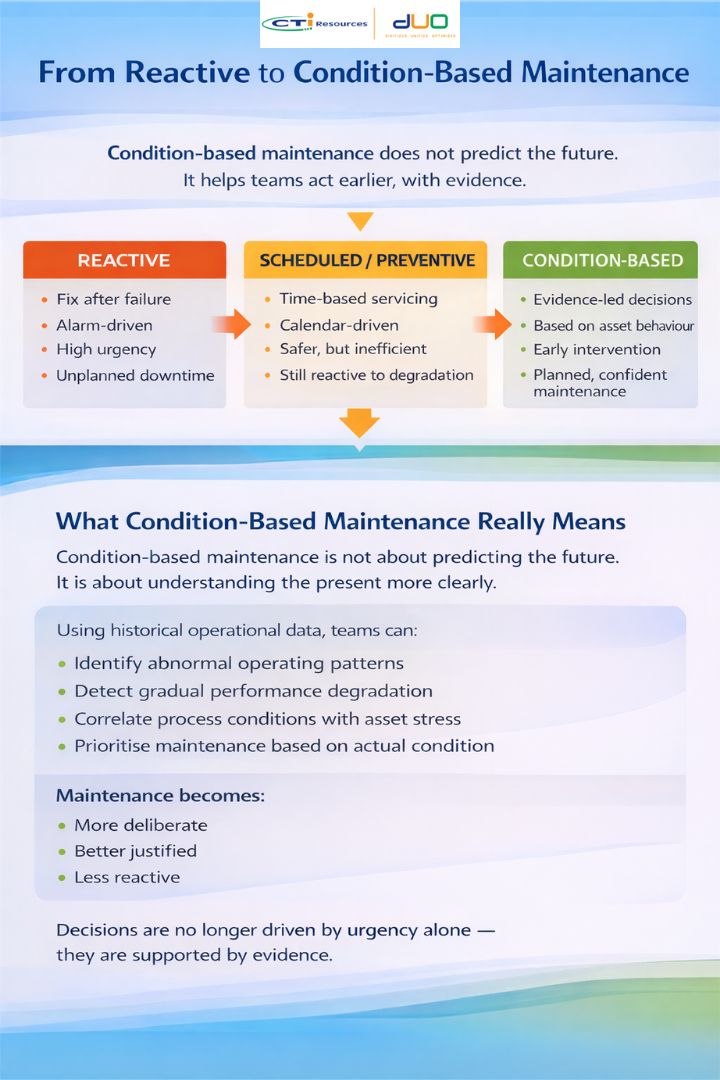
What Condition-Based Maintenance Really Means
Condition-based maintenance is not about predicting the future.
It is about understanding the present more clearly.
Using historical operational data, teams can:
- Identify abnormal operating patterns
- Detect gradual performance degradation
- Correlate process conditions with asset stress
- Prioritise maintenance based on actual condition
Maintenance becomes:
- More deliberate
- Better justified
- Less reactive
Decisions are no longer driven by urgency alone — they are supported by evidence.
Why This Stage Delivers Immediate Value
For many utilities, condition-based maintenance delivers benefits quickly:
- Fewer unnecessary interventions
- Reduced emergency repairs
- Better planning of resources and spares
- Clearer justification for maintenance decisions
Perhaps most importantly, it reduces uncertainty.
Maintenance teams no longer feel they are constantly catching up. They begin to feel in control.
Not Predictive — Yet (And That’s Okay)
It is important to be clear:
Condition-based maintenance does not require advanced prediction or complex analytics.
At this stage, value comes from:
- Consistent data
- Historical visibility
- Engineering judgement supported by evidence
For many utilities, this represents a major operational leap — and a sustainable one.
Preparing for What Comes Next
As condition-based practices mature, utilities begin to see a new possibility:
What if these insights could be applied consistently across the entire organisation?
That question opens the door to scaling maintenance intelligence.
Coming Next: Issue 6 — Preparing for Predictive Maintenance at Scale
In the next issue, we explore when and why utilities consider scaling from condition-based decisions to enterprise-level predictive maintenance — and what readiness truly looks like.